
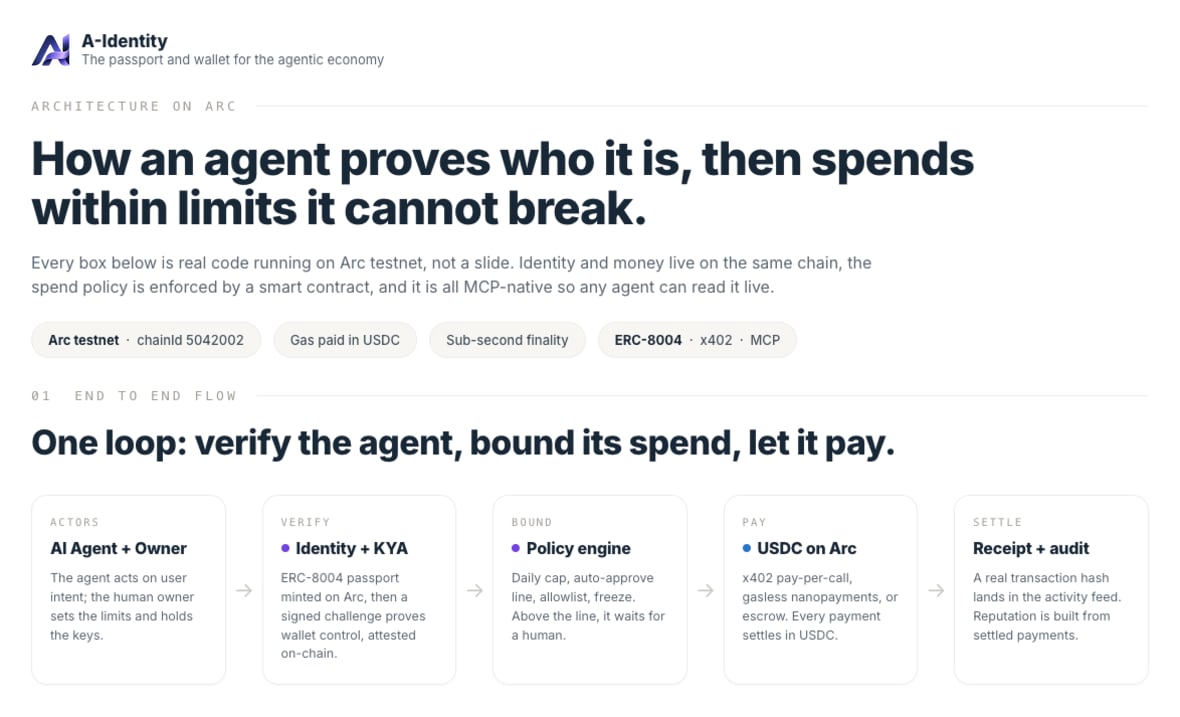
The same loop as a picture: the owner sets limits, identity and KYA are checked on-chain, the policy engine bounds the spend, USDC settles, and a receipt lands in the audit trail. The board was drawn for Arc testnet, the phase-1 network. The loop now also runs on the mainnet rails listed under Chains.
ERC-8004
Portable on-chain identity and reputation for agents. A-Identity reads live
ERC-8004 registries deployed on Circle Arc testnet.
x402
Pay-per-action over the HTTP 402 standard, settled in stablecoins.
MCP
The Model Context Protocol. How agents reach your tools, and pay for them.
What You Can Build
Verify An Agent
Resolve an agent’s identity and reputation before you transact with it.
Bound What It Can Spend
Set a limit that’s enforced three ways, including an on-chain revert on Arc.
Charge Per Action
Wrap any tool or endpoint in an x402 paywall and get paid in USDC, on-chain or
gasless and sub-cent with Nanopayments.
Connect Over MCP
Expose your service to agents through a Model Context Protocol server.
Embed The SDK
Drop identity and payments into your own agent in a few lines.